Updating Toyota’s 1KZ‑TE Oil Recommendations for 2026: Part 1
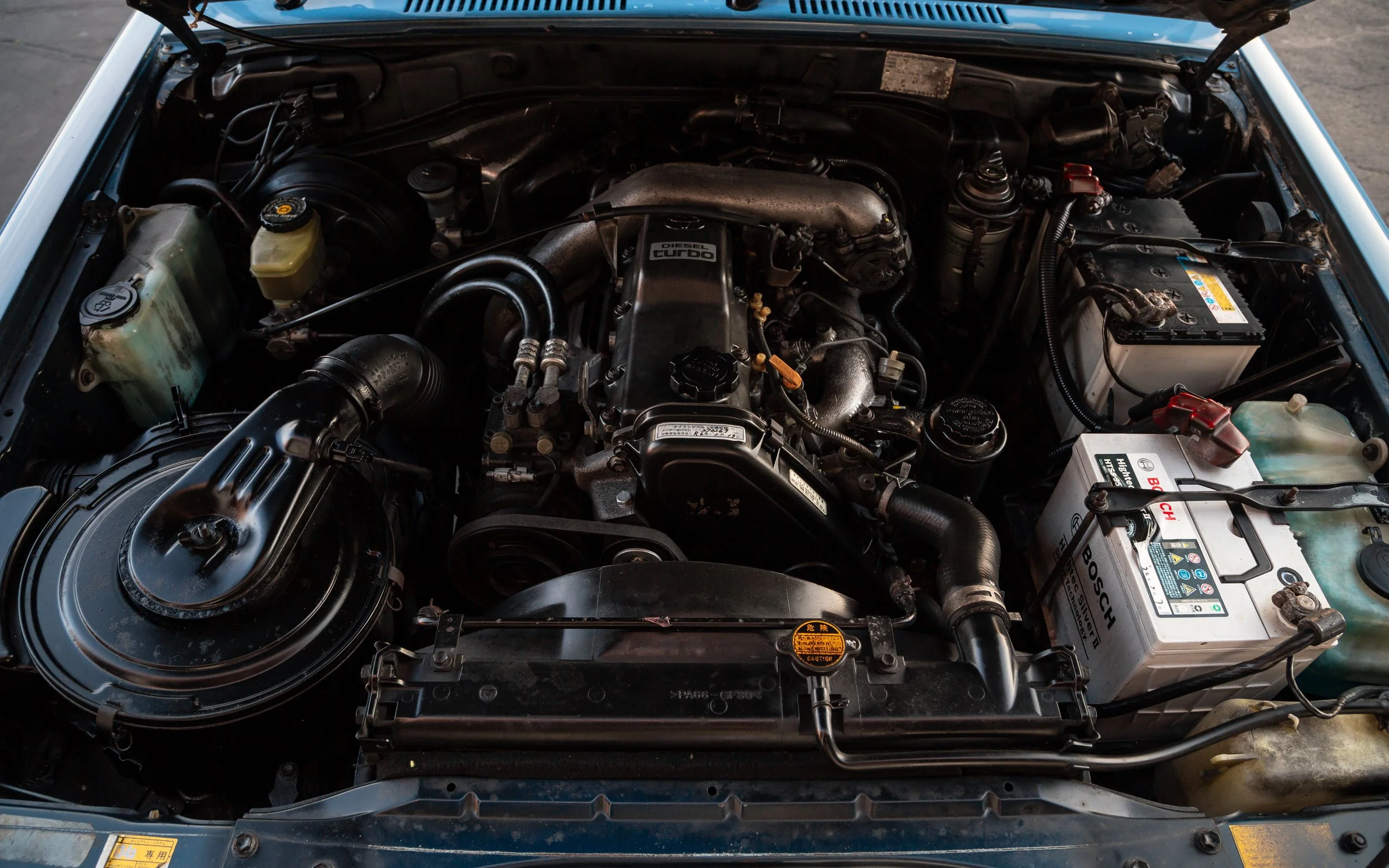
Part 1: Toyota’s Intent and the Baseline Plan
There are two guaranteed ways to start an argument in the Hilux, Prado, and Surf world: ask which lift kit is “best,” or ask what oil you should run. This series is about the second one, because I have watched the oil debate loop for years with the same ingredients every time. Viscosity wars, synthetic versus conventional, and brand loyalty dressed up as engineering. Then someone drops the classic closer: “My buddy ran that oil and his engine blew up.”
Maybe he did. Maybe he didn’t. Either way, that story does not tell us what Toyota designed the 1KZ to tolerate, or what Toyota actually required in service. If we want to stop arguing and start making good decisions, we need a baseline that is tied to Toyota’s intent, not our habits.
Here is the core idea that drives the whole project: Toyota did not tell you to run a brand. They told you to run an oil that meets a performance standard. Once you accept that, the discussion stops being personal and starts being testable.
What this project proves and what it does not
Let’s set expectations up front as this is where oil threads usually go off the rails. This project is built around virgin oil analysis (VOA), meaning the oils are tested brand new, out of the bottle. A VOA can tell us how an oil starts life: viscosity at the published grade, alkaline reserve, and broad additive system indicators. It is useful for comparison because it lets us look at multiple oils under the same conditions, at the same starting point.
A VOA cannot tell us how the oil will behave after thousands of miles of soot loading, fuel dilution, heat cycles, and contamination. That is the job of used oil analysis (UOA) and long-duration testing. I am not running a controlled endurance program here. I do not have the time, instrumentation, or budget for that kind of study, and pretending otherwise would be dishonest.
What I can do, and what I am doing, is establish a defensible baseline tied to Toyota’s original service-category intent, then compare modern oils to that baseline in a repeatable way and publish the data. Toyota already did the expensive part when they engineered the damn thing: the durability work, the validation, and the “will this survive real service” testing that I am not set up to reproduce in my garage.
My job here is different. I’m translating Toyota’s original performance envelope into the modern world, where the exact oils and categories from the 1990s are not sitting on shelves anymore. Think of this as an apples-to-apples starting line comparison that updates the options, not a decade-long endurance race that tries to redo Toyota’s homework.
It’s Not the Oil—It’s the Standard Stupid
Toyota’s factory service information for the Hilux diesel platform is not interested in brand loyalty. It does not mandate a proprietary Toyota formula, and it does not tell you that the engine “needs” synthetic or “can’t tolerate” synthetic. In fact, Toyota does not refine or manufacture engine oil in-house. Toyota-branded oil is a private-label product supplied by ExxonMobil, the same giant behind Mobil 1, and it is blended to Toyota’s requirements and sold under Toyota’s label because, yes, Toyota is still a business.
Toyota does something more useful than telling you to buy a logo. It specifies a performance category.
In the service documentation for the 1KZ-TE platform, acceptable engine oil is defined by service category. The categories commonly referenced include API CF-4 or CF, and alternatively Global DLD-1 (G-DLD-1). Older categories such as API CE or CD show up in older documents as acceptable for the era.
Here are the documents to prove it:
Toyota Hilux Diesel Service Manual (G-DLD-1)
Toyota Prado Warranty & Service Booklet (G-DLD-1) (pg 38 of the PDF.)
That detail changes everything. Toyota constrained the 1KZ-TE to a performance envelope, not a label on a bottle. If an oil meets the envelope, it meets Toyota’s requirement. If it does not, it does not matter how good the marketing is, or how loudly a forum thread insists it is “the best.”
Engine oil in plain English
Engine oil is not one magic ingredient. It is a base fluid plus a chemistry package that is designed to survive a hostile environment. The two big components are the base oil and the additive package.
The base oil is the bulk of the fluid. It drives viscosity behavior, film strength, volatility, and cold-start flow. The additive package is the part that does most of the protection work. Detergents and dispersants help keep deposits and soot under control. Anti-wear chemistry protects high-contact areas like the valvetrain. Corrosion inhibitors, antioxidants, and other additives help the oil survive heat and contamination without falling apart.
This is why “good oil” versus “bad oil” is usually an argument about additive systems, even when people think they are arguing about brand.
A quick word on viscosity
Viscosity still matters, but it is not a cheat code. A grade like 10W-30 describes cold-flow behavior and viscosity at operating temperature. It does not guarantee soot control. It does not guarantee shear stability. It does not guarantee deposit control. Two oils can share the same viscosity grade and still behave very differently in a diesel, especially when the oil is asked to manage heat, oxidation, and soot.
That is one reason Toyota leaned on performance standards in the first place. Viscosity tells you how thick the oil is at a couple of reference points. A performance standard tells you whether the oil survives the job.
What a performance specification actually means
API categories and global standards are not brand endorsements, and they are not ingredient recipes. They are test-based frameworks that define minimum outcomes an oil must achieve in strict standardized engine and laboratory tests.
In plain terms, a performance specification is Toyota saying: “Pick an oil that can prove it controls wear, deposits, soot, oxidation, and corrosion to at least this level.” The spec usually does not care how the oil gets there. It cares that the oil passes.
This is why Toyota could reference CF-4 or G-DLD-1 without publishing an additive formula. Toyota did not need to. The standard itself is the filter.
Global DLD-1 matters here because it was built for light-duty diesel engines from the pre-aftertreatment era. It is outcome-based. It expects an oil to control deposits, manage soot without runaway viscosity increase, protect valvetrain components, resist corrosion, and remain stable under heat.
You will also see alkaline reserve, commonly discussed as Total Base Number (TBN), show up in this conversation. Diesel service produces acids. The oil needs enough reserve chemistry to neutralize them. For this project, TBN is part of the story, but it is not the whole story.
If you want to go deeper on the actual science behind all of this, including tribology and what is really inside engine oil, I wrote a Part 1.5 that dives into the details. If you don’t, whatever, I don’t care.
You can read that here: https://www.landsurfer.net/blog/diesel-engine-oil-explained
Establishing the OEM baseline
If the goal is an objective comparison, the baseline needs to reflect Toyota’s original intent—not a modern oil shaped primarily by aftertreatment requirements. That means anchoring to the historical service category Toyota referenced when these engines were designed.
For that baseline, I selected Toyota RV Special Diesel Oil, a Toyota Genuine product sold in Japan. This oil is formulated to CF-4-equivalent performance and is explicitly designated for diesel vehicles without DPR (Diesel Particulate Active Reduction; basically a EGR or DPF). While Toyota now shows it alongside newer DL-1 and C5 oils for reference, the usage designation is clear: this is a non-aftertreated, engine-first oil. CF-4 predates DPR and DPF systems entirely, and this formulation reflects that era’s lubrication assumptions rather than emissions-driven constraints.
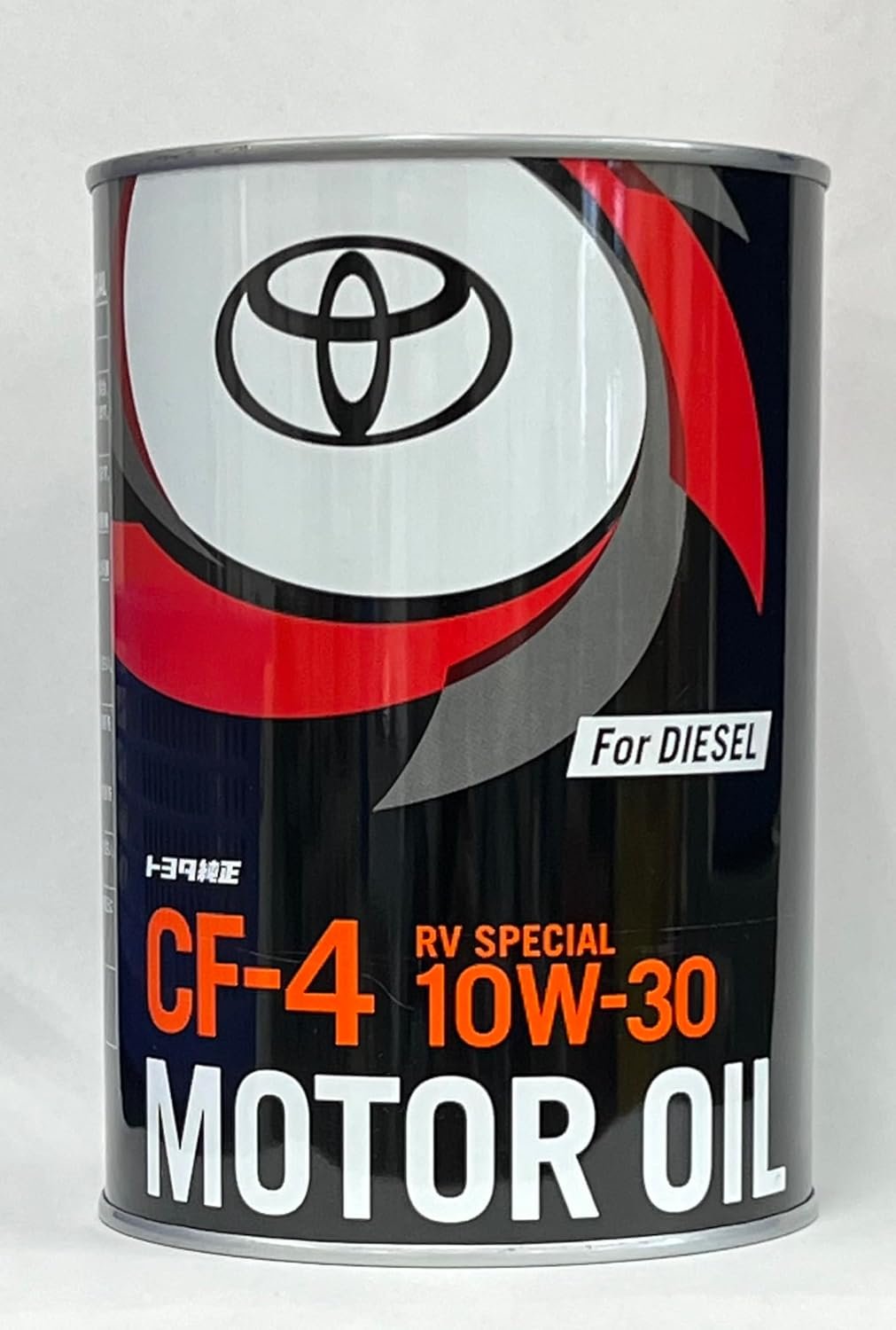
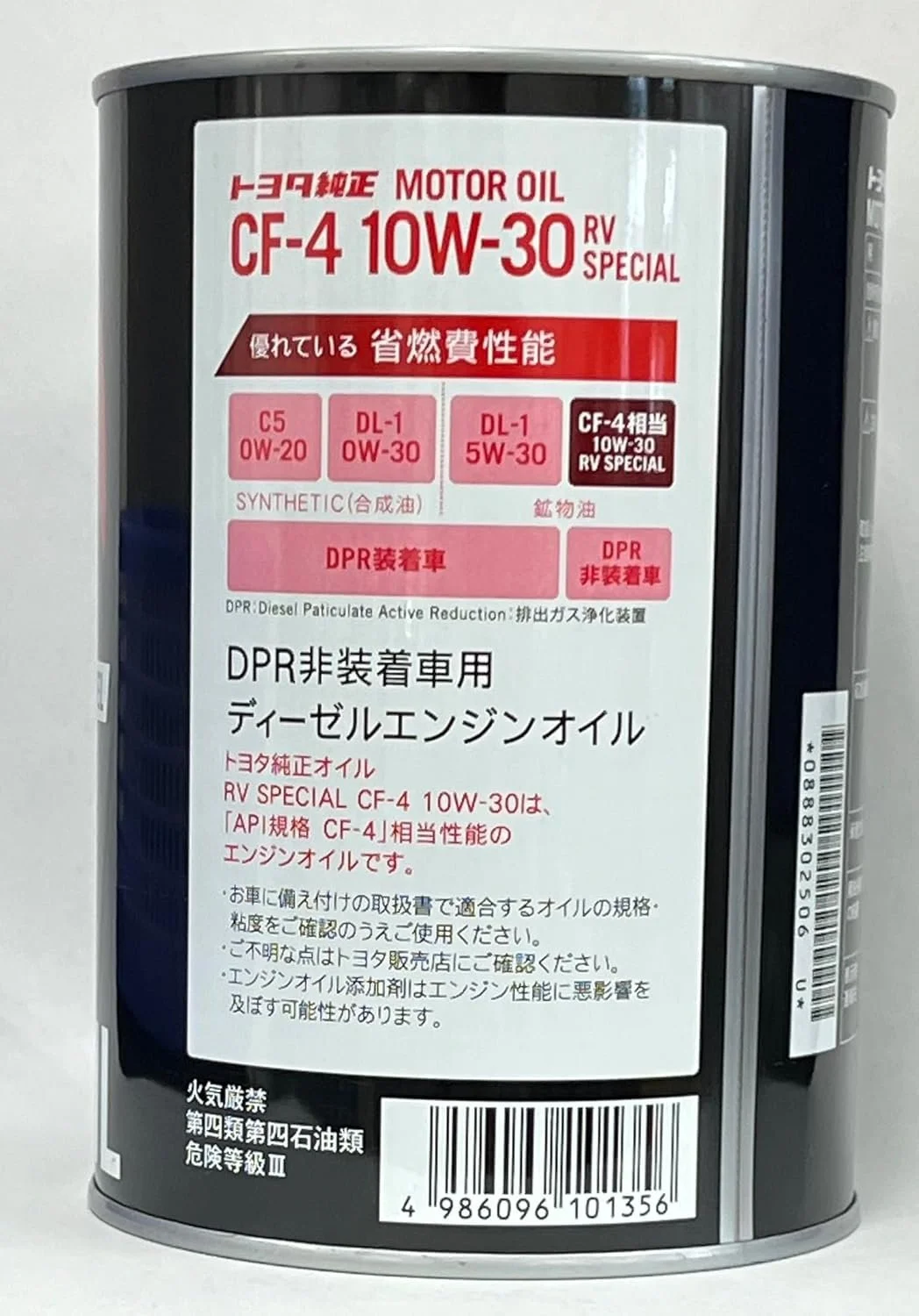
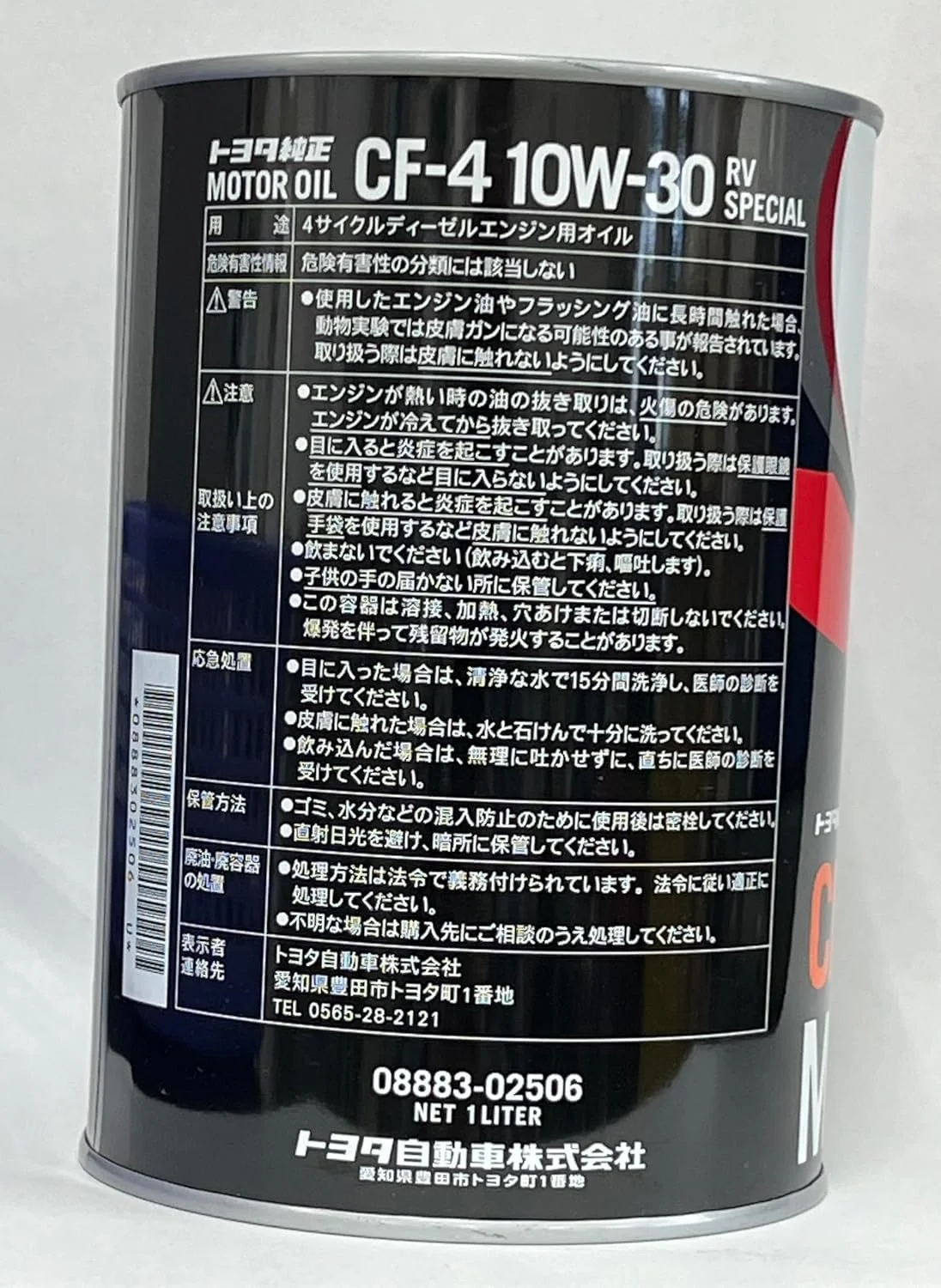
I am not claiming Toyota RV Special is a perfect time capsule. I am saying it is an OEM-branded oil intentionally positioned for non-DPR applications and aligned with the service-category intent Toyota originally specified. That makes it a defensible baseline—and the closest OEM proxy I’ve found—for a non-aftertreated engine like the 1KZ.
The plan
The methodology is intentionally simple. First, I am anchoring the baseline to Toyota’s service-category intent and using Toyota RV Special as the reference oil. Next, I will select modern contender oils in the same viscosity grade and the same general use category. These will be heavy-duty diesel engine oils that normal people can actually buy, not obscure unicorn blends that exist only to win an argument.
Then I will run virgin oil analysis on the Toyota baseline and the modern contenders using AMSOIL’s Oil Analyzers service. After that, I will compare the results against the baseline and against the intent of the CF-4 and G-DLD-1 performance envelope. Finally, I will publish the data, explain the logic, and make a recommendation based on evidence.
No brand loyalty. No bull-s%#*. Just a clean comparison.
A teaser for Part 2
I am not going to cherry-pick three oils that make my favorite look good. The selection rules will be explicit and defensible, and the lineup will represent how people actually buy oil.
Part 2 will lay out those rules and the exact oils, across clear tiers: a conventional heavy-duty diesel oil for the “keep it simple” crowd, a synthetic blend for the practical middle, and a boutique full synthetic for the premium option. Because it is so common in this community, I will likely add a mainstream full synthetic as a fourth contender.
What’s next
Part 2: Choosing the Contenders (selection rules, the exact oils, and why the lineup is fair)
Part 3: Lab Results and Recommendations (VOA results from AMSOIL Oil Analyzers, comparison tables, and an evidence-based recommendation)
If you are tired of oil threads that end in “agree to disagree,” you are in the right place. This one ends with numbers.